My Journey to Mewat
 Monday, September 30, 2013 at 11:20PM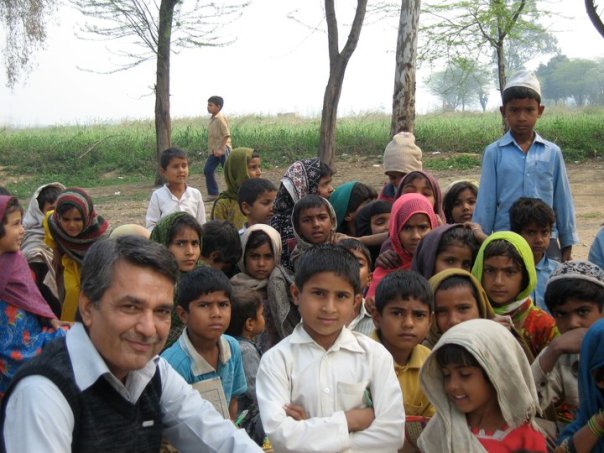
By: Suraj Kumar
It started with a visit in August 2007 to Pahari village, located in the Hathin block of Mewat district, Haryana, India. Lotus Outreach’s Director of Field Operations, Glenn Fawcett, and I met with distressed village women who had several complaints regarding the poor conditions of the government schools. At the time, I had no experience in rural government schools as I had been working in New Delhi as coordinator to the Right to Education Task Force, whose primary focus was allotting free seats in private schools to poor children. Interestingly enough, I had attended a government school only 28 kilometers away from this very village when I was a child; but things were different back then. The quality of education has deteriorated in the last 30 years and the reasons are well known. The middle class has stopped sending their kids to government schools and children from poor families are the only ones left in attendance. Their parents are busy enough earning two square meals a day to have the time to visit schools and monitor their children’s progress.
My task, as assigned by White Lotus Trust, was to improve the government schools in the Hathin block of Mewat district. For me, this was very compelling. Mewat is my birthplace and I am well acquainted in dealing with parents and teachers in these villages. I started visiting schools and found very few children in attendance and a scarcity of teachers. The reason, the teachers claimed, is the children simply don’t come to school. The parents hotly argued that children do not attend class because either the teachers don’t show up, or they might even show up, but do not teach. Meanwhile, the government was offering cash incentives to children from poor families, much of which was being pocketed by unscrupulous teachers because parents hadn’t been informed about the incentives.
As a first step, we initiated community meetings where we brought teachers and parents face to face and asked parents to explain why they were not sending their children to school. The teachers, startled by the parents’ complaints, promised to make the schools functional again. Piece by piece, things started falling into place. We took up the matter of the incentives by first informing parents of their existence. Right away, parents started demanding the pocketed incentives from teachers. Next, we wrote to the government about the teachers’ robbery and suggested they advertise the incentives so that parents could be well aware of the program. The government did more than that. They not only advertised incentives in the newspaper, but also went a step further by demanding schools open bank accounts for all eligible children through which incentives could be disbursed directly to parents.
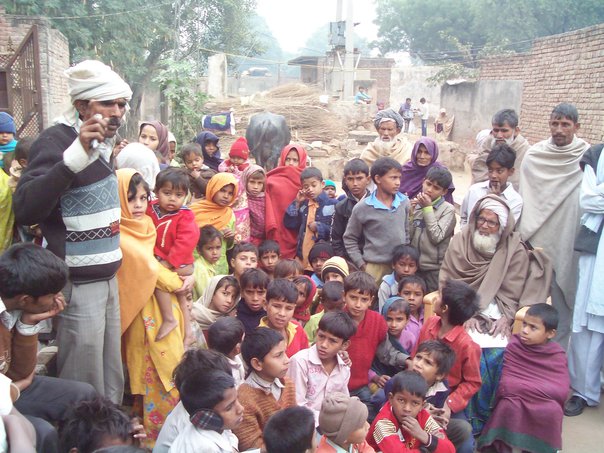 Parents voice their concerns.
In 2009, we observed a growing interest of parents to send their children back to school. To encourage this trend, we started an enrollment drive for schools with low attendance and offered a free school bag to all newly enrolled children. The results were impressive; a huge number of children enrolled. The timing couldn’t have been better: the Children’s Right to Free and Compulsory Education Act of 2009 (RTE) was passed by the Indian Parliament and implemented on April 1, 2010. The RTE gave us teeth. Our next target was widespread corruption among teachers who were charging inflated fees to parents. We launched a campaign across 600 villages in Mewat asking parents to refuse to pay the inflated fees. Almost overnight, we started receiving threats from teachers and there were even some attempts to manhandle us. We were obviously hitting them where it mattered most – their pockets.
To avoid further confrontation with teachers and corrupt school officials, we filed a petition against the inflated fees with the Haryana High Court. Almost instantaneously, the Directorate of Elementary Education invited me to participate in a seminar – a seminar, which I found out, was only called to determine who I was and how I could be controlled. At the seminar, I focused on the lack of infrastructure at schools all over Mewat: no toilets, no boundary walls, and no drinking water in 540 of 600 schools. I presented authenticated government data and records that were acquired under the Right to Information Act. All of the officials at that seminar, including the Haryana Director of Education, recognized that I could not be challenged.
Later, at a Haryana High Court hearing, the State Program Officer (SPO) of the Haryana government did not even make eye contact with me. Following the hearing, I confronted him and asked what his objective was. The SPO said that all he wanted was to improve the schools in Mewat to avoid the High Court’s reprimand. I asked him how we could be adversaries then, if we are both working for the same cause! We should be allies, working in collaboration! Not surprisingly, he was convinced! We became good friends after that.
The superiors in the Haryana government were less apprehensive after listening to the SPO explain my intentions. As a first step towards greater cooperation, the SPO and the Haryana Secretary of Education, the highest official of the Education department, and myself had a meeting with several non-governmental organizations to launch a second enrollment drive. I suggested that there should be no financial support to NGOs for the campaign, to which the government reacted positively. Six NGOs agreed to join forces for the enrollment drive. White Lotus Trust, together with the SPO, designed a program called “Dastak-E-Taleem” (Knock for Education) to be implemented in all Mewat schools, 600 in total. In one month, the program enrolled over 1,000 children. Emboldened by the impressive results of the campaign, the state government of Haryana approached the Government of India with an offer to organize the launch of the national campaign “Right to Education”. Over 5,000 parents and teachers attended the event on November 11, 2011. Impressively, the Speaker of Parliament, the Education Minister of India, the Chief Minister of Haryana, and the Education Minister of Haryana were all present. The event brought Mewat district to center stage in India.
The campaigns motivated the Haryana Education Department in a positive direction and fostered the central leadership’s appreciation of the Haryana state government. Visits to each and every household of over 600 villages ensured that teachers and NGO representatives enrolled thousands of children. Additionally, the government announced several measures to improve the quality of education and to provide badly needed infrastructure improvements.
One of the most significant outcomes is the Haryana government’s drive to constitute School Management Committees (SMCs) in compliance with the RTE Act of 2009. Training of newly elected members, 75% of whom are parents including 50% mothers, is essential. These trainings bring parents, teachers, government officials, and the NCPCR (National Commission for Protection of Child Rights, which I represented in Haryana as their State Representative) face to face and raise the issue of accountability for all those involved in the improvement of the schools. Parents began to see how the RTE was actually a powerful weapon in their hands once they were trained on how to use it effectively. I have always advocated for the capacity building and empowering of parents because they are the only ones with the largest stake in the schools, and have the willpower to change them. I am quite hopeful that these schools will see considerable improvements because of the spirited involvement of parents. In fact, we are already seeing lots of changes on the ground. Here is a list of the four most notable outcomes:
- All children ages 6 to 14 are now enrolled in schools all over Mewat.
- Children are receiving on time all of their entitlements, such as cash incentives, books, stationary, school bags, and uniforms.
- SMCs are monitoring and ensuring that teachers come to school on time and stay in school.
- The Principal Secretary of Education of Haryana visited Mewat at least 10 times during last the two years to meet with parents and officials, which has prompted greater accountability. (This hasn’t happened for over 20 years!)
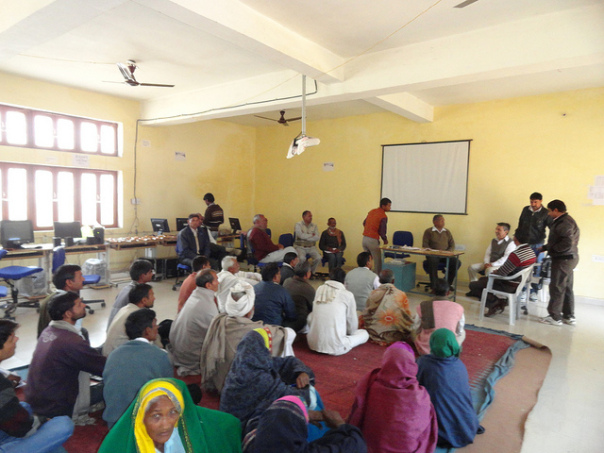 School Management Committee training - the heart of the village school model
Another significant outcome is the Haryana government’s creation of an official Facebook page to follow Mewat school improvements. Many teachers have posted frequent updates about their schools, as well as tips for good teaching practices. Some of the more disgruntled teachers are voicing their complaints and even showing reluctance to change. Haryana Education Department officials post their reports on Facebook following school inspections and then invite comments from parents and teachers. Such use of Facebook is something unique in the Indian context and still difficult to digest for many. In any case, the highest government officials see these posts daily. Haryana is the only state in India to have done this.
I have also seen a huge shift in an area that was particularly problematic for student attendance. It was assumed and accepted that children do not attend school during April and May, the last two months of the ongoing academic session. In rural areas this is harvest time and marriage season; add to that the heat and nobody complained that children did not attend classes. The government’s remarkably creative solution was to announce that these two months shall be used for non-academic activities. As an alternative, teachers at all 15,014 elementary schools in Haryana were trained in several extracurricular activities to make attending school more attractive during these hot, busy months. Activities include field trips to cultural sites, temples, police stations, banks and railway stations, and in-school extracurricular activities like painting, dancing, singing and clay modeling. Many teachers post photographs of the activities on Facebook everyday, a fact that is appreciated by everyone.
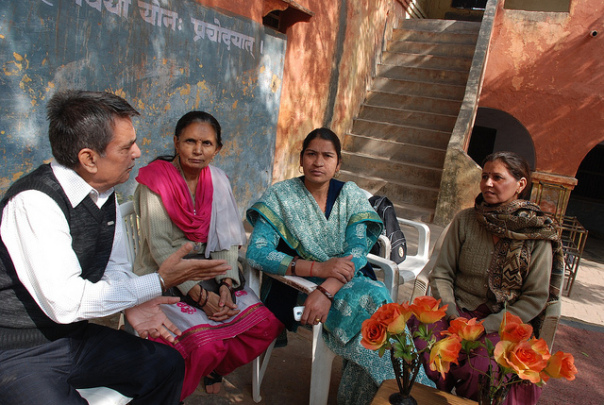 Talking with teachers in Mewat
In May of this year I was passing by a school in Tauru and was amazed to see a huge number of children in school, which until the new activities was very unusual. I was even more surprised when the teachers said that attendance averages 80% during May because of the non-academic activities.
I am so happy to observe a real sea change in the attitude of parents, teachers, students and the Haryana government, and a complete turn around in student enrollment. To be sure, there are three greater challenges ahead: firstly, we must ensure the regular attendance of all those enrolled throughout the academic year; secondly, we still have to make sure the teachers are teaching properly; and thirdly, we must improve infrastructure at the hundreds of schools that have insufficient classrooms and inadequate facilities. Keen oversight of well-trained School Management Committees together with marked cooperation of the Haryana government will, without a doubt, overcome these challenges!
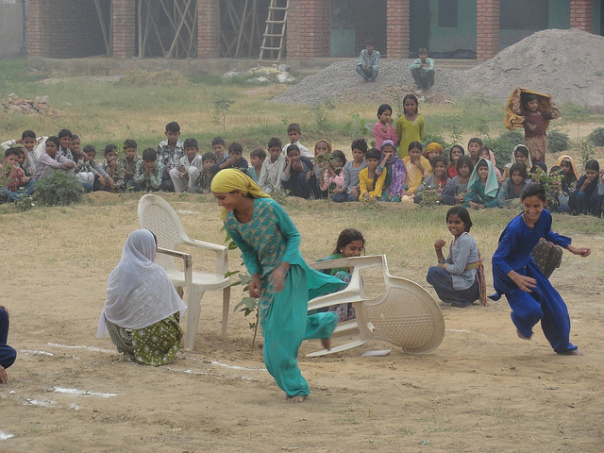 Extracurricular sports day in May 2013